Types of Alopecia
Hi, I'm Damaris from naishair toppers
In the consultations that I'm asked for, I talk with many women who have other types of alopecia different from mine, which is androgenic alopecia.
I have been studying other types of alopecia and some treatments and also real cases of women who have alopecia and seeing what has worked for them.
I wanted to mention that it is always advisable to see a specialist, a dermatologist, so they can diagnose you, since with any illness, having a diagnosis helps you accept the situation and also helps you know what steps you need to take.
I hope that this article and my personal perspective as a woman with alopecia and how I feel about it, and also sharing what I have been able to learn from talking with dozens of women, is useful to you.
So let's get going...
Telogen effluvium alopecia
There is Acute telogen effluvium when it is a one-off thing and Chronic telogen effluvium, which is when this type of alopecia extends over time for more than six months.
In this case of alopecia, what happens is that the root of the hair follicle has suffered specific damage and so its growth is interrupted.

This can be due to a specific situation, such as, for example, surgery or an infection or some traumatic event or stress.
I imagine you all know a woman who has gone through this and describes that her hair fell out in clumps, for example, she noticed those clumps were left in the shower, in the bed or on the sofa, or there are many of them who, perhaps after childbirth, which is a rather traumatic moment, develop this type of alopecia.
The good thing about this type of alopecia, well, in quotation marks, is that in most cases, since it is something isolated and one-off, no type of treatment is needed, but you have to let some time pass for the hair to renew itself, since from when this trauma occurs until the woman notices, about two or three months pass.
So, it is something that will recover on its own.
Did you know that in the case of chronic telogen effluvium, they sometimes recommend minoxidil in lower doses, but the clinics insist that it is only to speed up the natural process, not to cure it?
I find it interesting to say this, because we are tired of trying a lot of things that have worked for other women but not for us, so you have to take into account that perhaps in many of those cases where it works, anything or nothing would have worked, because the body itself would have made the hair grow back.
Frontal fibrosing alopecia
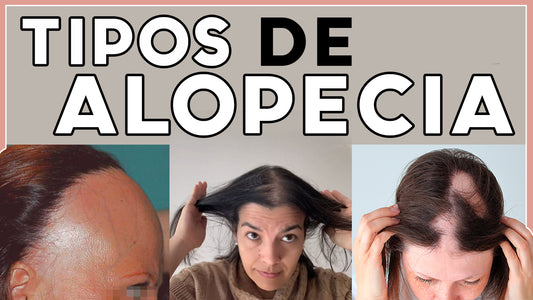
This type of alopecia usually occurs in women after menopause; as you can see in the image, it is a case where the hair seems to recede backwards. You can even lose the hair of the eyebrows.

Frontal fibrosing alopecia in women seems to be due to an autoimmune and hormonal cause, and there is no curative treatment.
The only thing that can be done is to try to stabilize it. There are treatments such as antiandrogen medications or anti-inflammatory therapies, but again, when this type of medication or treatment for alopecia is applied, in this case, the goal of the treatments is to stabilize but they do not usually manage to improve it.
Alopecia areata
Perhaps you may remember people who have oval patches of hair loss, where all the hair has fallen out. There are usually 1 to 5 patches, and if there were more, it would be multifocal alopecia areata.

If they lose the hair on the whole head it would be total alopecia areata and if the hair falls out from the body hair all over the body, then it would be Universal alopecia areata.
The clinics say there is no curative treatment for alopecia areata, but when some type of treatment is applied, it is important to keep up the treatment, because there are usually relapses.
The hair can be recovered, but the hair that has been recovered can also fall out again, and the evolution is unpredictable.
They can last months or years, or perhaps it can resolve on its own. So if the clinic recommends a treatment for alopecia areata and it helps in some way for the hair to reappear, that is why it has to be kept active.
What treatments for alopecia areata are recommended? Anti-inflammatory medications, microinjections, corticosteroid lotions, etcetera are usually recommended.
It is important that you know that the available treatments could also affect your own body, since we are talking about things like corticosteroids or, in the case of micro injections for alopecia, I have spoken with women who have had microinjections of different kinds and found them very painful.
There are certain medications that are contraindicated at certain moments of your life or with other types of treatments you may have. So it is important to know the options and to know personally what you would need.
Androgenic alopecia
This type of alopecia is the most common. It is the one I have, and female androgenic alopecia ends up affecting up to 25% of women throughout their lives.

What causes androgenic alopecia? It can have hereditary hormonal causes, medical conditions, and it is also a normal part of aging.
So the goal of using a treatment for androgenic alopecia is to slow down the progression of the alopecia.
If you started with this type of hair loss before menopause, when you go through menopause it will be a little more noticeable than if you had kept your hair and started with this problem after menopause.
The clinics say that therapies have to be maintained over the long term to keep the results. They also say that it is not necessary to maintain them for life, but the longer they are used the better the result will be.
If they are stopped, you can lose the improvement you had obtained over time, so again, it is something you have to take into account if you want to be medicated.
After all, they will surely be medications that you will have to take for life although, on occasion, it may be due to some nutrient deficiencies or some thyroid problems.
I think many of us have had thyroid tests to find out whether it might be related to the female alopecia we suffer from, or perhaps other types of problems cause the alopecia, be they hormonal problems, like those women who have polycystic ovary syndrome.
To keep androgenic alopecia at bay or as a form of treatment, a lot of women are recommended to follow a diet, such as the keto diet, or to eliminate certain foods, such as foods with gluten or dairy.
I have tried a low-carbohydrate diet and the truth is that it did me good overall, but my hair did not recover.
I have also spoken with a woman who is celiac and still has alopecia, which makes me think that, as the clinic says, alopecia in women is generated by multiple factors and every person is a world of their own.
That is why the clinics mention that there is no treatment to cure alopecia, but rather to stop or slow down hair loss and prolong it over time.
In my case I never had a lot of hair, so there is a part that is also normal, which is aging. Hair gets thinner as one gets older.
So, even if I were now to miraculously recover the hair I had when I was a teenager, it would be thinner, even more than it was then.

Density is also lost with age, so in my case I have preferred not to undergo a treatment that affects me in other ways, in order to possibly not recover everything I would like.
It's not worth it for me, but it is something each person decides, especially given the number of treatments that exist.
For example Dutasteride or finasteride, minoxidil, microinjections etc. In all these cases, as we have seen, these treatments do not cure, but they slow it down, and they also have to be maintained for life.
There are women who have told me that they sometimes had a rebound effect when they stopped taking the treatment for some reasons, such as because they became pregnant, because they were in another psychological treatment that is not compatible with this other type of treatment, etc.
So, well, it is something you have to think about and make a conscious decision depending on your type of alopecia.
Solutions for alopecia
Aside from the treatments mentioned before, some clinics give other options as a solution for alopecia.
One is hair transplant and another is full hair prostheses.
Hair transplant for alopecia

As for hair transplant, the truth is that I don't find many testimonies from women who have done it.
This makes me suspect that it is not the best option, but I could be wrong.
The problem is that if you have alopecia and you get the hair transplant, you have to continue with your medical treatment, taking the medications to prevent the rest of your hair from falling out, and to me, it doesn't seem a very interesting option considering it costs about ten thousand euros.
Hair transplant for men I have seen is quite a bit more common, but it's not clear to me that a hair transplant for women with alopecia is the best option.
Integrated hair system for alopecia

The integrated hair system is another option, but it's a bit like the case of hair transplants for women, and that is that, again, I haven't seen much information or many women who talk about it.
A while ago, a woman who was using it contacted me recently and told me she didn't feel comfortable, but I don't know exactly what she was referring to.
I have seen on the internet that there are some hair prostheses of this type, which are like a mesh where the hair comes out through little holes naturally, so it ends up totally integrated.
This mesh is integrated with all the hair, like a natural hair topper, but it has to be attached to your own hair with rings or micro rings.
In the case of these clinics the difference is that it is not a mesh, but a biopolymer and the advantage is that you can go bathe, you can go to the beach, you can shower, sleep, and you don't need to take it off.
In the case of this prosthesis the average lifespan is a year and a half, something that seems quite optimistic to me, since I have had my prosthesis for a year and I take it off to sleep, to bathe, etcetera, and I don't go to the beach or the pool with it.
The drawback of the integrated hair system is that you have to go every six weeks to have it repositioned. Considering that it is about five thousand euros, plus the sessions of going back every six weeks, well, in a year it can be quite expensive.
Conclusion
The world of alopecia is immense, every case is different and you have to get very well informed so as not to lose time, resources and money on treatments that may not do anything for you.
If you need a consultation about natural hair toppers, don't hesitate to write to me and we can schedule a video call where we can talk and share ideas, experiences and possible solutions.